
The Symbolism of Newroz: What The Myth Knows
Nergiz flowers pushing up through the last of the cold earth, sequins catching the March sun from the hems and shoulders of Kurdish dresses, blankets unfurling across fields and mountains, and somewhere close by, a glass of tea being held between two hands of someone who has been waiting all year for this time of the year. Greenery slips over the city, and at last Newroz, the new day, arrives.
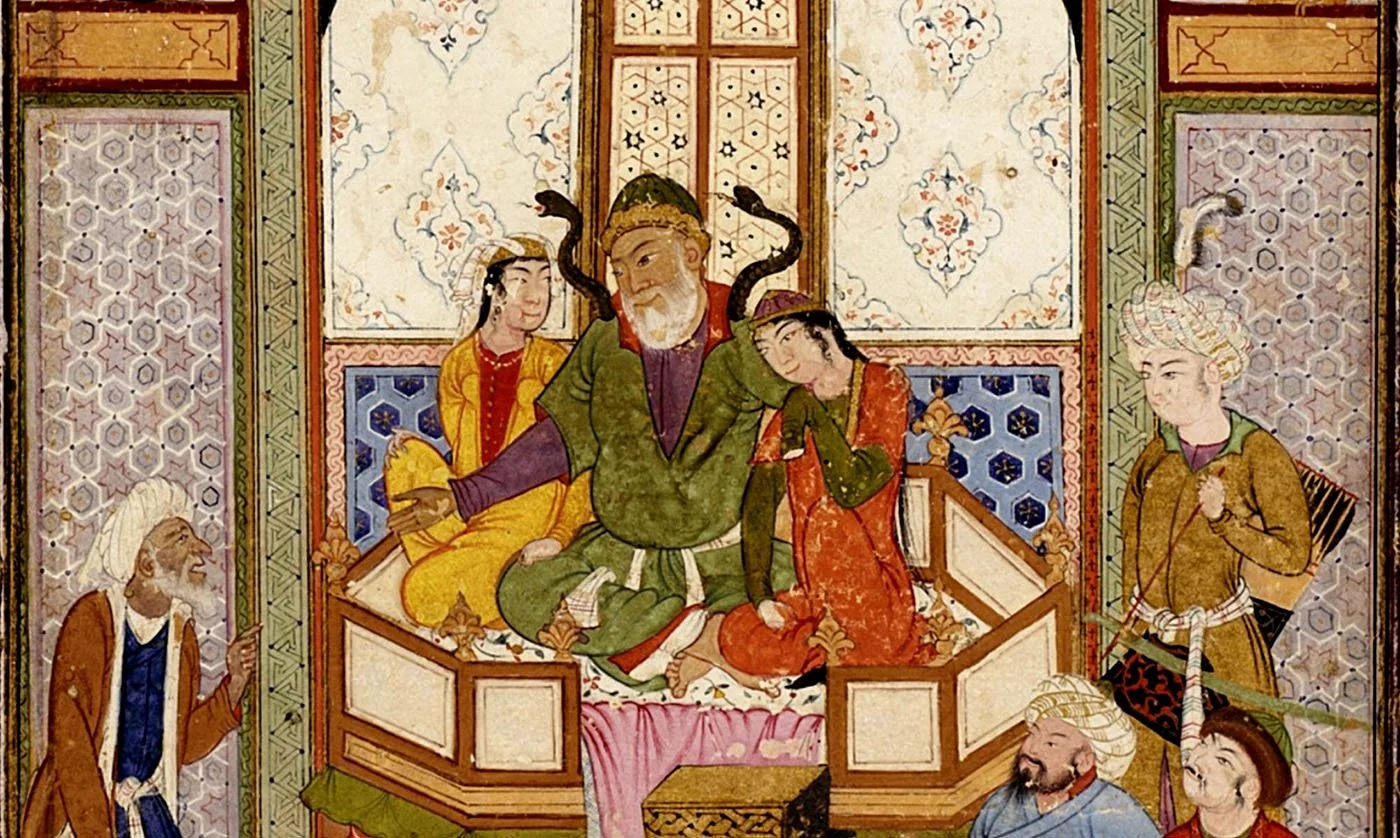
But beneath the holiday lives the mythological story of Kawa the blacksmith, which is shared across Kurdish, Persian, and wider traditions, with its origins stretching back to pre-Islamic antiquity. In the Kurdish version, Kawa’s children, along with all the children of the town, were taken to feed the shoulder-serpents of the tyrant king named Zahak; Kawa’s grief became fury, and his fury became a hammer—the hammer that finally struck Zahak down with the help of all the help of the community. To signal the liberation, he climbed to the highest mountain to light a fire, letting all the valleys below know that it is over and spring is here at last.
Joseph Campbell, writing on the sociological function of mythology, describes myths as “an organization of symbolic images and narratives metaphorical of the possibilities of human experience and fulfillment." The keyword here would be metaphorical; rather than literally documenting, the myth takes the full weight of historical oppression and compresses it into simpler binaries. Tyranny takes the shape of a body with snakes, and resistance takes the shape of a worker raising his tool, showcasing exactly how the grammar of myth works; it strips the noise from the question until the only question remaining is, "What do you do when power demands too much?" The answer becomes impossible to avoid.
Zahak is not a complicated villain. What he represents is appetite without limit, and crucially, the serpents are not separate from him; growing from his shoulders and extending from his own body, they are sustained by his authority. They feed on the brains of the young and therefore on their capacity to think, imagine, and refuse. And Kawa, as we know, is a blacksmith—a man who works with his hands, who then bears the hammer he put his work into. Quite literally, he’s a figure of creation and reshaping; in the same way that he transforms raw materials with heat and force, he also forges real change. Zahak consumes; Kawa produces. The tyrant feeds on others to sustain himself, while the blacksmith shapes tools through labor and effort. The myth is deliberate in these choices.
And myths do something quite different from what we see in modern literature with the way they create such solid binaries instead of tending towards interiority and the particularity of individual experience. By presenting resistance as something so decisive and embodied, the story highlights a pattern that history has seen repeatedly: power grows excessive, the excess becomes monstrous, and the monstrosity provokes refusal. It is exactly the fact that Kawa belongs to no single historical moment that he can be borrowed by any of them. The narrative can be mapped onto various contexts without actually naming any of them, precisely because it is all compressed into symbols. Any person who has lived inside a structure that demanded their silence and fed on the futures of children already knows Zahak and already knows what the serpents—or the tools of the system—look like.
So every year on the 21st of March, Kurds light the fires again. As a group divided among four states, whose language and culture have been systematically suppressed throughout generations, the fire doesn’t only serve as a celebration but also a continuation of Kawa’s fire, the same signal of freedom sent from the same mountains. It's a reminder that the story can still be true and resistance has always been possible; that this capacity to resist does not belong to the few and never did.
And somewhere tonight, tucked in bed by a heater, a child could be hearing the story for the first time, whether it is being read from a book or remembered aloud. The child won't yet know what they are receiving, but the story always knows. It has been finding its way into new hands for thousands of years.
An old story, it is, but never not relevant.
- Meena Nabaz