
What Barham Salih’s UNHCR Appointment Means for AUIS
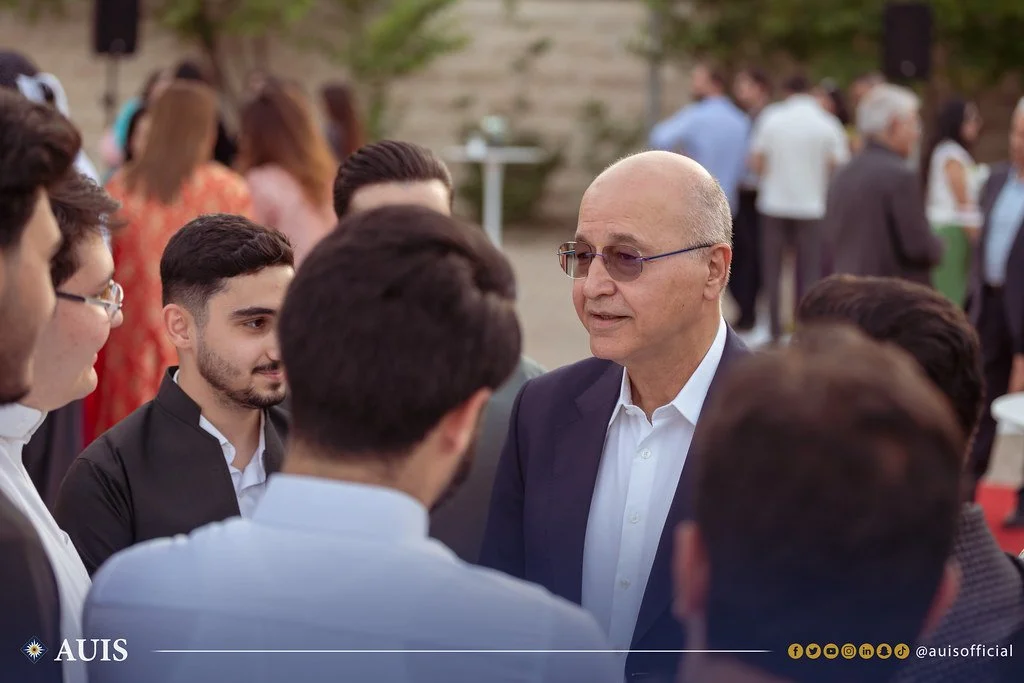
Photo by AUIS.
The appointment of former Iraqi President Barham Salih to lead the United Nations High Commissioner for Refugees (UNHCR) marks a historic first, with a non-Western leader heading the agency for the first time in nearly half a century. For the American University of Iraq, Sulaimani (AUIS), however, the moment carries a more intimate resonance rooted in lived displacement, education as refuge, and a long-standing commitment to those forced from home.
Salih, who fled Saddam Hussein’s regime as a young man and pursued his studies in the United Kingdom, framed his campaign around personal experience. “I believe deeply in the mission of UNHCR because I have lived it,” Salih said during his campaign for the role, according to Reuters. That belief has not only shaped his political career but also the educational institution he helped found in Iraq’s Kurdistan Region.
Established with a vision of international-standard education in a post-conflict society, AUIS has, over the years, become more than a university. It has emerged as a quiet but consistent sanctuary for displaced students—particularly those whose academic lives were abruptly interrupted by war, persecution, and political collapse.
Following the Taliban takeover of Afghanistan in 2021, AUIS opened its doors to over 100 students from the American University of Afghanistan (AUAF), many of whom were forced to flee the country after universities were shut down and academic freedoms were erased. For these students, Sulaimani became a place to continue an education that violence had attempted to end. AUIS hosted, supported, and integrated Afghan students into its academic community, preserving not only their studies but their sense of intellectual continuity and dignity.
Similarly, AUIS has welcomed Kurdish students from Syria who arrived in the Kurdistan Region as refugees after years of conflict. Many came with disrupted schooling, uncertain legal status, and the psychological toll of displacement. At AUIS, education functioned as more than instruction—it offered structure, safety, and the possibility of rebuilding futures paused by war.
These experiences reflect the very principles Salih now brings to the global refugee stage. His vision for UNHCR emphasizes placing refugees at the center of humanitarian responses while recognizing that aid alone is not enough. “Humanitarian assistance is meant to be temporary,” Salih has said, emphasizing the need for long-term solutions rooted in opportunity, inclusion, and self-reliance, as reported by Reuters.
For AUIS, Salih’s leadership of UNHCR reinforces the university’s founding philosophy: that education is one of the most durable responses to displacement. While UNHCR grapples with unprecedented global displacement—driven by conflicts in Gaza, Sudan, Ukraine, and beyond—and severe budget constraints, the AUIS experience offers a microcosm of what sustainable refugee support can look like when education is prioritized.
Salih’s dual legacy as a former refugee and as the founder of an institution that has actively welcomed refugees adds credibility to his leadership at a moment when humanitarian principles are under strain. It also places AUIS in a unique symbolic position, as a university born in a fragile region that has quietly practiced the values now urgently needed on a global scale.
In a world increasingly hostile to displacement, the AUIS story suggests a different narrative: one where being a refugee does not end ambition, and where education remains one of the most powerful forms of protection.
- DeaBtt