
The Invisible Thirst: Why AI’s Water Footprint Demands Youth Climate Action
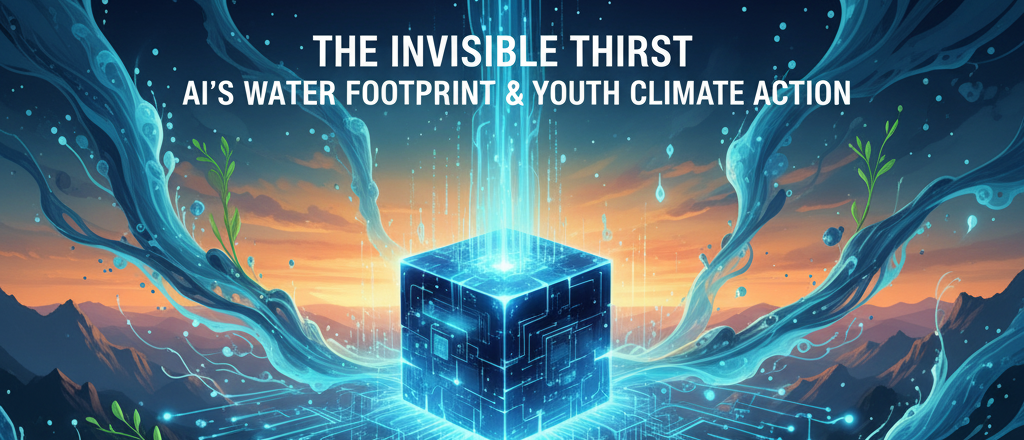
The humming cloud in our phones, the machine that answers our questions — it all feels weightless. But what if that cloud isn’t air at all? What if it’s water — our most fragile, finite lifeline, turning into steam to keep the world’s servers cool? Artificial Intelligence (AI) has become our modern genie.We summon it to write, design, translate, predict, and plan. It’s sold as a savior, the ultimate weapon against inefficiency, even climate change itself. Yet, the truth hiding behind all that digital shimmer is that AI drinks water. A lot of it.
Training just one large AI model like GPT-3 can evaporate enough water to fill two-thirds of an Olympic swimming pool (University of California, Riverside, 2023). Modern data centers, the beating hearts of AI, can consume 1–5 million gallons of water per day (Environmental and Energy Study Institute, 2024). That’s enough to sustain a small city.
Now, place that beside Iraq’s reality. In the summer of 2025, Iraq faced its worst drought in eighty years, water reserves collapsed to just 10 billion cubic meters, less than half the 18 billion normally needed to start the season (Kurdistan24, 2025). The Ministry of Water Resources had to cancel the entire summer agricultural plan, redirecting every drop toward drinking water (The New Region, 2025)
In the Kurdistan Region, the picture was just as grim. Dams fell to record lows, and rivers thinned to near-drought levels, threatening not only crops but household supply (Rudaw, 2025). Some districts faced up to 12-hour water cuts daily, forcing families to buy water at inflated prices (Hawlati News, 2025).
Now ask: how can a single AI data center, running in some region, gulp up millions of gallons a day while our dams in Darbandikhan and Duhok are gasping for air? How do we justify that contradiction, that our future technologies are cooling servers while our farmers watch their fields crack?
This is not an argument against AI. It’s a call for awareness and for action. AI is important. It’s transformative. It can optimize irrigation, predict droughts, and design sustainable cities. But it’s also a mirror, reflecting our ethical blind spots.
Because zero-water AI is possible — through closed-loop systems, liquid immersion cooling, and recycled water loops that can cut usage by over 80% (Planet Keeper, 2024) — the technology exists to significantly reduce water use. What’s needed now is innovation, investment, and smart planning to implement these solutions in regions where water is scarce, like Iraq and Kurdistan.
So, what should we — the youth of Iraq and Kurdistan — do about it?
First, learn. Understand that every online query, every AI-generated image, carries a hidden water cost. Our generation must redefine what “digital responsibility” means.
Second, speak up. Challenge the narrative that technological progress must come at environmental cost. It doesn’t have to.
And finally, always believe that alternative ways are possible. Change can happen when you think of how else we can do what we have always done in a certain way.
We can’t let the servers hum while the rivers die. We can’t let “the future” dry up the present. AI should not be the thief of our water, but the tool that helps us save it. The fix exists, what’s missing is urgency, and creativity.
- Asma Ali