
AUIS Student Artist Highlight: Interview with Rose Yousif
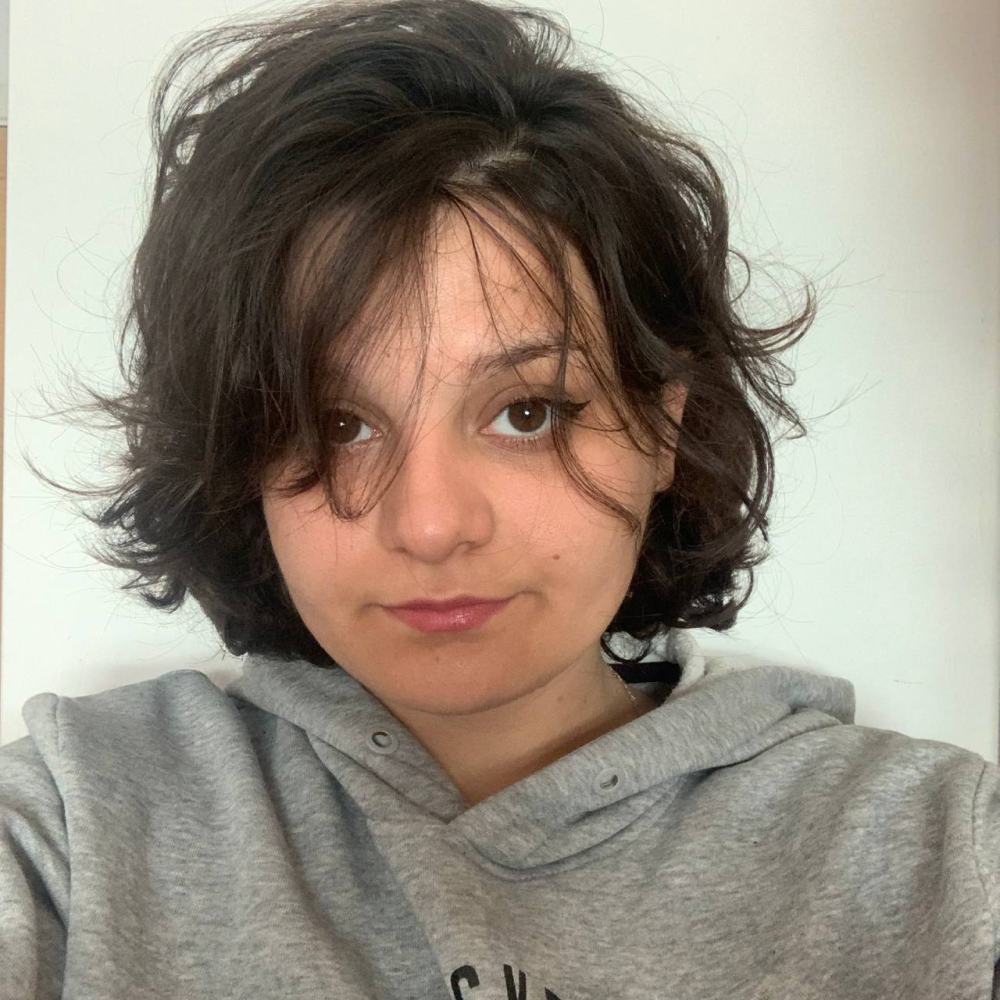
Rose Yousif is a multimedia artist as well as a first-year Mechanical Engineering student at the American University of Iraq, Sulaimani (AUIS). She grew up in Baghdad but is originally from an Assyrian Village, Qaraqosh (Baghdida), in Nineveh Plains. Rose’s mother graduated from a Fine Arts school in Mosul and was a significant influence on her. She participated in the Baghdad Walks IV exhibition, which is part of a series of group exhibitions in public spaces across the city hosted by TARBIK Baghdad at Baghdad’s International Train Station in 2021. She was also mentored by Lara Kobeissi, an XR artist based in London, UK, as part of a mentorship program hosted by AWAN Festival and Creative Space of the Station in Baghdad from December 2022 to March 2023. She decided to study Mechanical Engineering at AUIS because she loves doing Maths and Physics. She also wanted to explore Slemani more through living here.
Background & Journey:
Could you share what art means to you? What role does it play in your life?
I think art, for me, is an expression of a state of mind. It doesn’t have to be a particular story or a feeling for me to draw it. It could be just multiple things or thoughts in my mind that I might or might not understand, all coming together to form sketches on my paper. After I finish the sketch, I often think, “Yeah, this is exactly what’s going on there.” What is also interesting about art for me is that it doesn’t have to be therapeutic. I just strive to be expressive and do what I want, whether I understand it at the end or not.
How did your mother’s background in fine arts influence or inspire your own journey?
My mum graduated from a Fine Arts school in Mosul, and growing up, my siblings and I all had the chance to explore art because of her. She would give us crayons, color pencils, coloring books, and sheets of paper to keep us busy with something. A lot of the time, she was just trying to distract us from the shootings and bombings that were happening back then in Baghdad in 2011 when I was 7 years old. I think it was also a lot for my mum to handle four kids at the same time, and luckily, she chose those crayons. After that, all of us started drawing excessively, although not all of us continued. Most of the art materials she got us, looking back at it now, were of good quality since she knew what’s good and what’s bad to choose from as someone who studied Fine Arts.
Your Assyrian roots are a unique part of your identity. How do you believe your culture influences your journey as an artist?
Assyrian people are either focused on ethnicity or religion—in some cases, both. My family was more religion-focused, so I grew up not understanding my identity fully, especially being surrounded by Arabs in Baghdad most of the time, which created confusion when it comes to my ethnicity as an Assyrian. I believe this confusion is reflected in some elements of my art. Since generally, there is nothing that I explicitly show in my artworks, every part of my identity is represented in a way or another in my art. This is different from the art of my mum, which is more explicit when it comes to being Assyrian. She still has a lot of paintings from when she was in Mosul of herself wearing traditional Assyrian clothes. We had one of these paintings in my uncle’s house back in Mosul. It was a big painting of my mother wearing Assyrian clothes and holding a cross, but for some magical reasons, it was neither stolen nor burnt after ISIS came to Qaraqosh in 2014. It just survived, and we later moved it to our new house in Qaraqosh after the events.
Art & Artistic Mediums:
You use several art mediums (painting, digital and animation), how is the creative process associated with each one distinct for you?
Assyrian people are either focused on ethnicity or religion—in some cases, both. My family was more religion-focused, so I grew up not understanding my identity fully, especially being surrounded by Arabs in Baghdad most of the time, which created confusion when it comes to my ethnicity as an Assyrian. I believe this confusion is reflected in some elements of my art. Since generally, there is nothing that I explicitly show in my artworks, every part of my identity is represented in a way or another in my art. This is different from the art of my mum, which is more explicit when it comes to being Assyrian. She still has a lot of paintings from when she was in Mosul of herself wearing traditional Assyrian clothes. We had one of these paintings in my uncle’s house back in Mosul. It was a big painting of my mother wearing Assyrian clothes and holding a cross, but for some magical reasons, it was neither stolen nor burnt after ISIS came to Qaraqosh in 2014. It just survived, and we later moved it to our new house in Qaraqosh after the events.
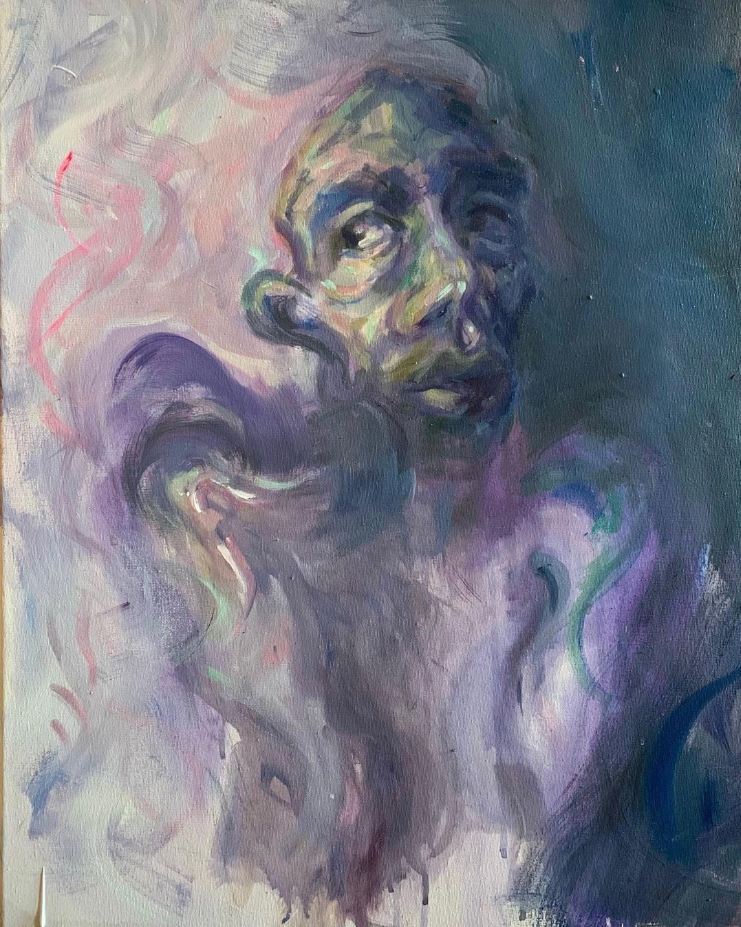
Credits: @ro.seart on Instagram
A recurring symbol/character in your art seems to be fish. Does fish hold any significance to you? Can you share the inspiration behind their presence in your work?
I remember when I was younger; every Sunday, after coming back from church, my dad would stop by the same grocery store each time, and next to it, there was a fish butcher shop. While waiting for my dad to do the groceries, I would stare at the fish outside the shop in the pool and empathize with them. Then, unconsciously, I think these images of killing and cutting stuck in my mind and later were showcased in my art. Later, I actually became vegan for three years for the same reason, but I’m eating fish again now [laughs]. What is interesting for me also with using fish in my art is that they don’t look like they are showing emotions because of their open eyes—their expressions are very subtle. You can achieve the same result by drawing a human without their eyebrows, for example. Sometimes it is not only about it being a subtle feeling; it can be a terrifying gaze or it can express emptiness.
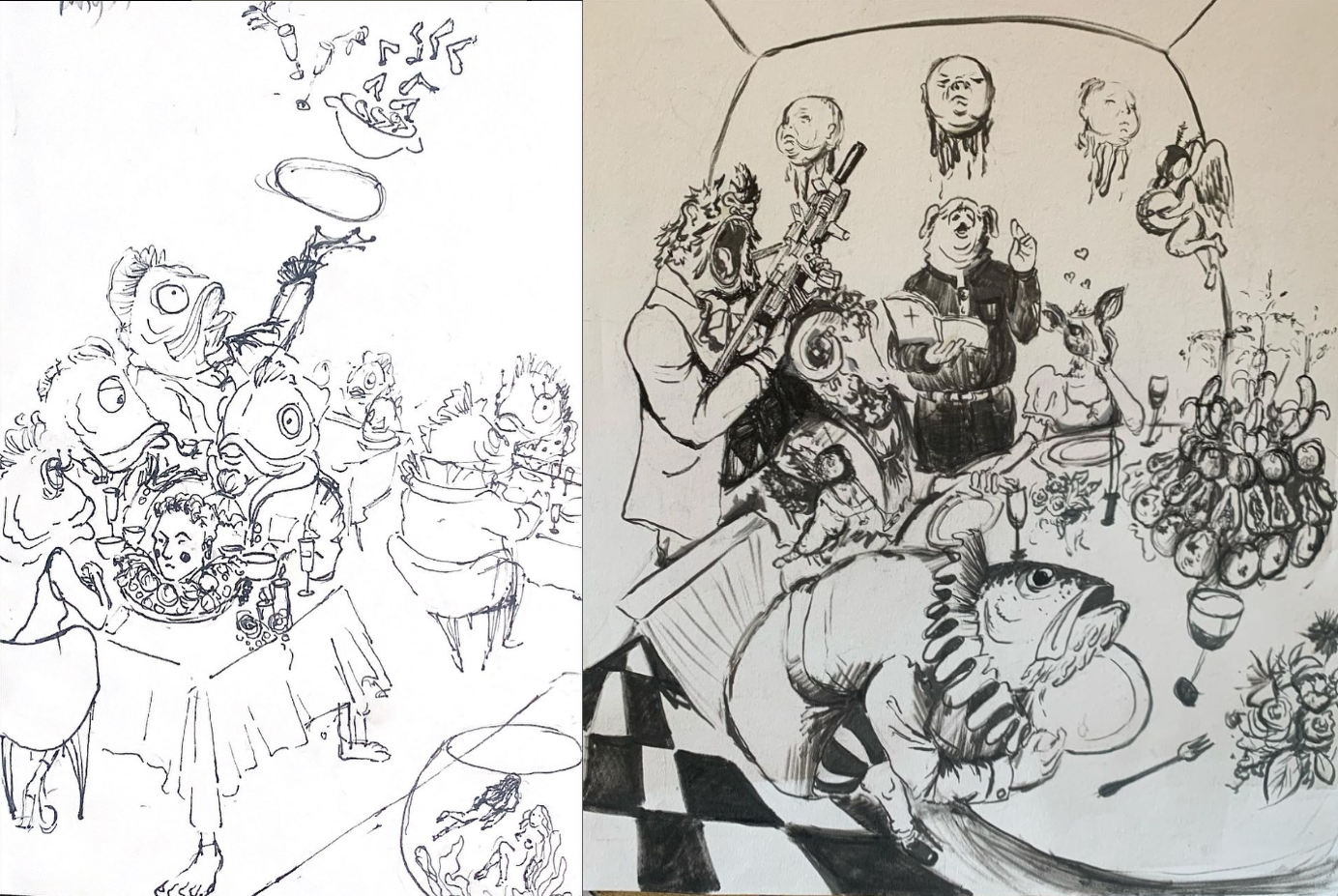
Credits: @ro.seart on Instagram
AUIS & Future Plans:
Since you have joined AUIS almost a year now, how do you prioritize between your academic performance and your artistic pursuits?
Since I joined AUIS, I haven’t worked on big art projects, only some sketches here and there. That is because of some personal reasons, but generally, I prioritize academics over anything else, and I rarely pursue art heavily during my studies. There are some art activities in AUIS as well, but the art scene here is not very developed and extremely limited to simple activities.
What are your aspirations and plans for the future as an artist?
For now, I don’t have solid plans, but I would like to focus more on animation and maybe make a little video during the holidays. During the university semester, though, it will be hard to do anything. But if I am able to put some time for art, I would like to organize some activities through the Art Club. For example, we can have some painting sessions. I think there are a lot of spots in AUIS that are worthy of painting, and it would be a nice group activity if we can gather some artists on campus through these kinds of activities.
- Zahraa Zahir