
80% of Syrians expected to return home from Germany, Merz says
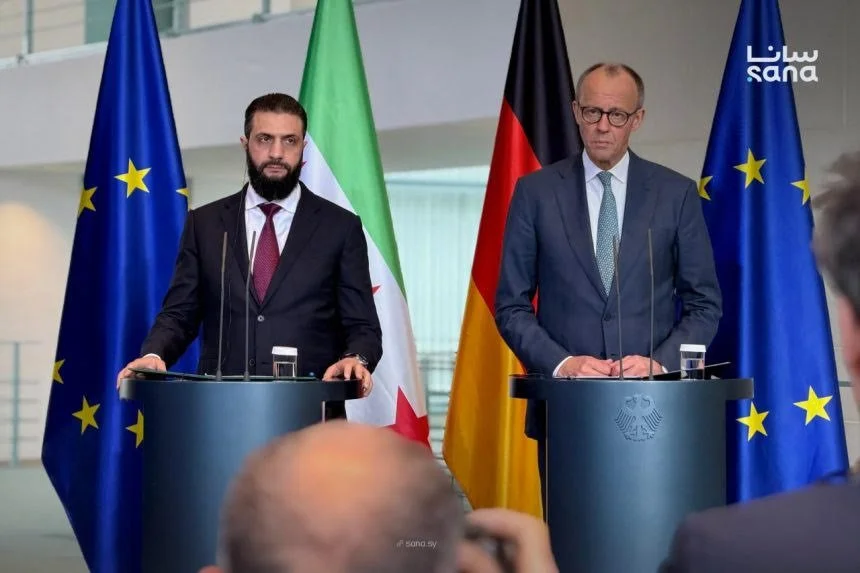
German Chancellor Friedrich Merz and Syrian President Ahmed al-Sharaa have recently
proposed that up to 80% of Syrian refugees in Germany could return to Syria within three
years. While framed as pragmatic and hopeful, the plan exposes a disconnect between
politics and reality.
At its core, the proposal rests on the assertion that Syria has fundamentally changed.
following the end of its civil war. From this perspective, the rationale is straightforward: if the
original causes of displacement have diminished, then the legal and moral grounds for
Protection must be reassessed. Merz has also suggested that many Syrians may wish to
return voluntarily to participate in rebuilding their country.
One of the most immediate obstacles is the degree of integration many Syrian refugees
have achieved in Germany over the past decade. A significant number have built stable
lives: they have jobs, families, and, in many cases, German citizenship. Their presence is
economically and culturally important. Nowhere is this clearer than in the healthcare sector.
Where Syrian doctors constitute the largest group of non-German physicians, numbering
over 5,700 by the end of 2024. Removing or even significantly reducing this workforce would
strain the economy and country’s welfare greatly.
This implied a central contradiction in the proposal. While Germany emphasizes return, it
simultaneously acknowledges the necessity of retaining certain skilled professionals, such
as doctors and carers. Departure is only selectively encouraged. Merz has also mentioned
that people who are integrated and law-abiding are expected to stay, as are those with
German citizenship, which makes up half of the Syrian-German population. For now, only
Those that have committed crimes or are on temporary protection statutes are asked to return.
Beyond Germany’s internal considerations lies a more fundamental question: is return to
Syria genuinely viable? Critics argue that it is not. Reports of unstable security conditions,
fragile infrastructure, and ongoing human rights concerns under the current Syrian
Governments complicate any assumption of safe and sustainable reintegration. For many
refugees, “return” comes with a lot of uncertainty and fear.
Indeed, migration research consistently challenges the assumption that return decisions are
primarily economic. Instead, social integration emerges as the most powerful determinant of
whether refugees choose to stay. Feeling connected—to neighbors, communities, and a
broader sense of belonging—plays a far greater role than employment alone. The situation
also reveals counterintuitive patterns. Interestingly, higher education levels and English
proficiency actually decreases the intention to stay, likely because these refugees have better
opportunities to move to other countries. In contrast, proficiency in German and having
Children enrolled in German schools significantly increase the likelihood of long-term
settlement.
Family dynamics further complicate the picture. Studies suggest that families with more
Daughters may be less inclined to remain, as those families are more likely to be concerned.
with preserving cultural norms and identities. Meanwhile, even living in refugee
accommodations—often assumed to hinder integration—can, in some cases, foster social
connections that strengthen attachment to the host country.
Against this backdrop, the proposed “circular migration” model attempts to reconcile
competing priorities. By allowing Syrians to move between Germany and Syria (contributing
to reconstruction without forfeiting their lives in Germany; it offers a more flexible alternative.
to permanent return. In theory, it acknowledges the hybrid identities many refugees have.
developed, as well as their desire to maintain ties to both places.
However, this model also raises practical questions. Circular migration depends on stability.
in both countries, legal clarity, and sustained political cooperation. Without these conditions,
It risks becoming more of a symbolic gesture than a functional system. Moreover, it does not
fully address the deeper issue: for many refugees, the concept of “home” has fundamentally
shifted.
In this light, the 80% return proposal simplifies thousands of lives and situations. While the
idea of rebuilding Syria with the help of its diaspora is compelling; it cannot be detached from
the conditions on the ground or the lives refugees have already built elsewhere. Ultimately,
Any sustainable approach must move beyond numerical targets and engage with the deeper
forces shaping refugee decisions.
- Vala Kamaran Jalal